





“Sovereign cloud” has become one of the industry’s most heavily marketed terms, making it difficult to separate genuine architectural constraints from headline-driven panic.
In our work we see the topic come up in two ways. Sometimes it is a genuine constraint that the existing architecture cannot satisfy. Sometimes it is a reaction to a headline. Distinguishing between the two is a critical prerequisite to any infrastructure investment.
What is Data Sovereignty Real Meaning ?
Define true data sovereignty in the cloud hinges on three immutable properties:
- Data must physically reside within a specific jurisdiction
- It must be governed strictly by local law
- The platform operator must be immune to extraterritorial legal obligations (such as those imposed by a foreign parent company).
The third property is the one that is easy to miss. For example, in a European context, the US CLOUD Act can legally compel a US-headquartered provider to hand over data, even if that data sits in an EU data center. Therefore, a deployment might achieve “data residency” while entirely failing to achieve “data sovereignty”. Conflating the two is a common architectural blind spot, and understanding the distinction is the foundation of any sound cloud strategy.
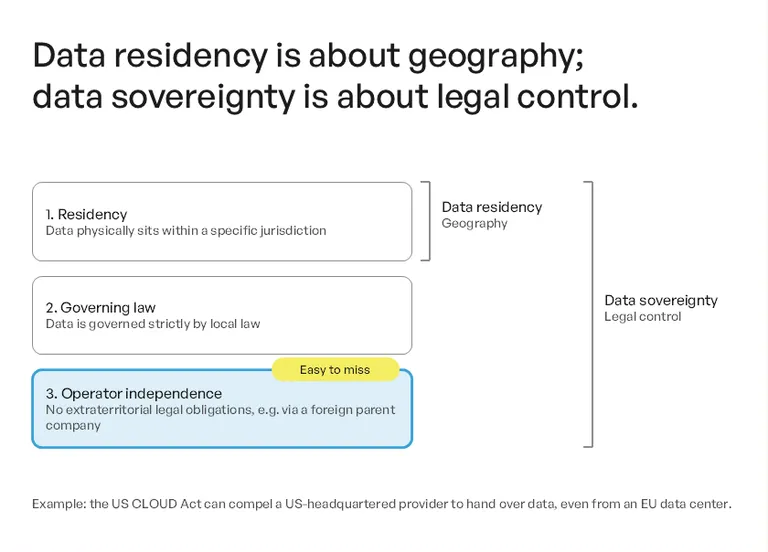
A useful way to frame it: data residency is about geography, data sovereignty is about legal control. They overlap but are not the same, and a contract or audit question almost always concerns the second.
When Data Sovereignty Is a Genuine Requirements
The concern is real when an external party with leverage over the business requires an answer the current setup cannot give.
In practice this could translate by:
- A regulator or auditor asks for a demonstrable account of who can access the data and under what legal authority.
- A customer or public-sector tender includes a residency or sovereignty requirement as a precondition for the contract.
- A sector-specific framework (financial services and the public sector are the common ones) imposes obligations that an extraterritorial provider relationship cannot cleanly meet.
In each of these, the cost of an inadequate answer is not theoretical. A tender requirement that is not met removes the bid from consideration. An audit question that cannot be answered becomes a recurring finding. These are concrete, and they are the situations where sovereignty work is justified.
When Data Sovereignty Is Not the Right Priority
If the data is not regulated and not subject to a contractual residency obligation, and no external party has raised the question, then sovereignty is unlikely to be the right priority. The mainstream hyperscalers are technically strong and operationally mature, and for a large share of workloads they remain the correct choice.
Moving to a sovereign arrangement carries real costs: migration effort, a narrower managed-service catalogue with some providers, and in some configurations a higher operational load. Those costs are justified by a requirement. Absent the requirement, the same money is usually better spent elsewhere. We have advised clients not to pursue sovereignty for exactly this reason.
The assessment is therefore not “is sovereignty good.” It is “does a party with leverage over us require it, now or foreseeably.” If yes, it should be addressed deliberately. If no, it can wait.
What a Sovereign Cloud Changes, and What It Does Not
It’s worth being clear that sovereignty does not improve the application. Performance, functionality, and developer experience are largely unaffected. What changes is the organization’s ability to answer the access and jurisdiction question with evidence rather than assertion.
That evidence has a specific form: a defined data location, an applicable legal regime, an operating entity without conflicting obligations, and an access log. For a regulated business this is the difference between an audit that closes and one that does not, and between a tender that proceeds and one that stops.
There is a secondary side benefit that is worth naming but not overstating. A sovereign foundation, particularly one built on open components, reduces dependence on a single vendor’s commercial terms. This is rarely the reason to undertake the work, but it is a real consequence and it tends to matter at the next renewal.
This matters more as switching becomes cheaper: under the EU Data Act, charges for moving data out of a cloud provider are capped at direct costs today and banned entirely from 12 January 2027. When leaving costs less, a credible alternative carries more weight at the negotiating table.
Migrating Legacy Systems to Sovereign Infrastructure Without a Rewrite
A recurring obstacle is the belief that sovereignty requires rebuilding the application. In most cases it does not.
An existing system can frequently be migrated onto sovereign infrastructure broadly in its current form, with modernization handled in stages afterwards. This keeps the system in service throughout and avoids the failure mode of a full rewrite, which is the option most likely to overrun and to break working functionality. Where a rebuild is genuinely warranted it should be a separate, justified decision, not an assumed precondition of the migration.
Cost of Action vs. Cost of Inaction
The cost of acting is reasonably estimable in advance: a scoped migration, a defined change to the operating model, and the ongoing cost of the chosen foundation. It can usually be staged.
The cost of inaction is harder to see because it presents as risk rather than expenditure:
- Where a residency or sovereignty requirement exists in the market, an inability to meet it removes the business from those opportunities, often without explicit feedback.
- An unresolved audit question recurs, accumulates, and in the in the worst-case scenario, lead to regulatory penalties.
- The absence of a credible alternative weakens the position at every renewal.
- Timing matters: addressed in advance it’s a planned project, addressed done after a client or regulator demands it, it happens under pressure, at higher cost and higher risk.
The point is not that inaction is always wrong. For some organizations it is the correct choice for now. The point is that the cost of inaction is real and should be assessed explicitly rather than treated as zero.
Where Open Source Fits in a Data Sovereignty Strategy
Open source and sovereignty are complementary rather than competing. An open, portable stack is what prevents a sovereign platform from becoming a different form of lock-in. For some organizations, sovereignty is the objective and open source is the means of preserving optionality; for others the priority is reversed. The relevant point for this discussion is that the open-source layer is what keeps a sovereign deployment movable, which is part of what makes the sovereignty durable.
Establishing this open-source sovereign foundation in the EU is greatly accelerated by leveraging specialized regional providers. We actively partner with STACKIT, a EU cloud providers, to deliver these robust, sovereign-by-design architectures.
Deciding Whether Sovereignty Applies to You
Sovereign cloud is a response to a specific requirement: the ability to demonstrate where data sits, which law governs it, and who can access it.
The decision turns on whether a party with leverage over the business requires that demonstration, now or in the foreseeable future. Where the requirement exists, the work is justified and is best done before it becomes urgent. Where it does not, the cost is rarely warranted.
At CBTW, we assess the precise regulatory and technical realities of your workloads. Our GRC consultants work hand in hand with data, cloud and infrastructure experts, backed by deep expertise in sectors where sovereignty is critical, such as banking, insurance and critical industries.
Where a move is justified, we design hybrid architectures using trusted EU providers like STACKIT. Where sovereignty isn’t required, we optimize your workloads on public hyperscalers such as AWS and Azure to reduce risk, cut costs and drive new revenue through high-performance, AI-ready environments.
In conclusion as partners of both hyperscalers and trusted EU providers like STACKIT, we have no commercial reason to recommend sovereignty where it is not needed. To discuss whether the requirement applies in your case, contact us.