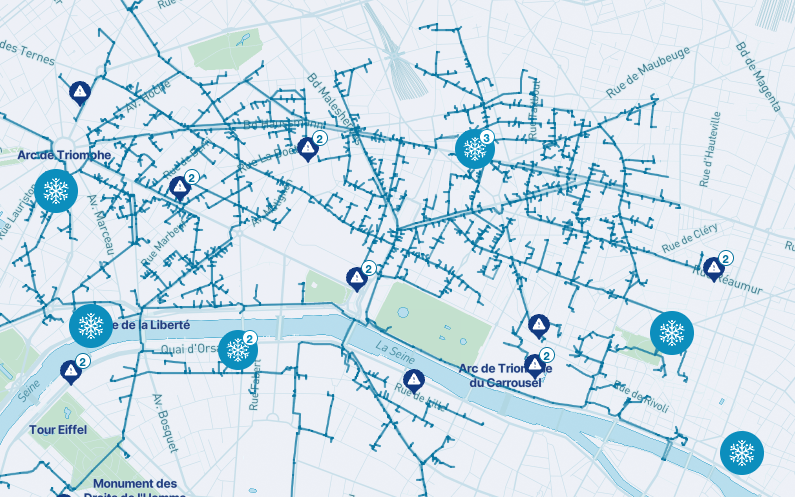
This case study covers a customer portal redesign, redevelopment, and legacy modernization project for Fraîcheur de Paris moving the company from an outdated legacy stack to a modern, scalable architecture. A dedicated team of engineers fully redesigned and redeveloped the portal over four years, from application development through ongoing evolutions and maintenance.
Context & Key Challenge: Why the Legacy Stack Needed Modernization
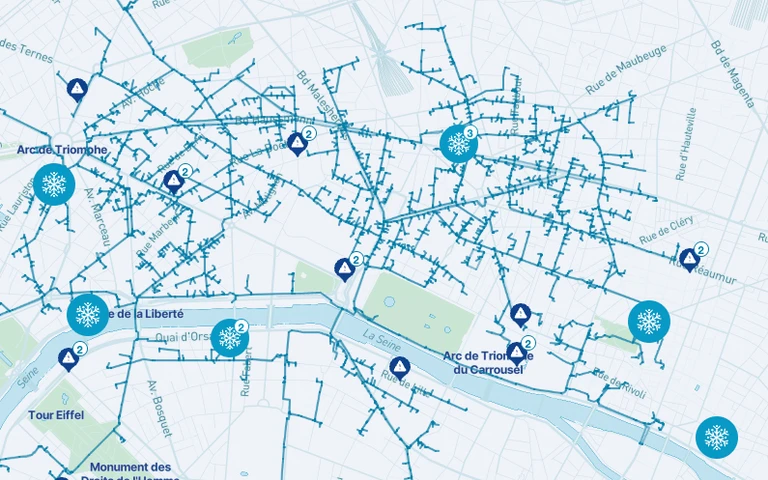
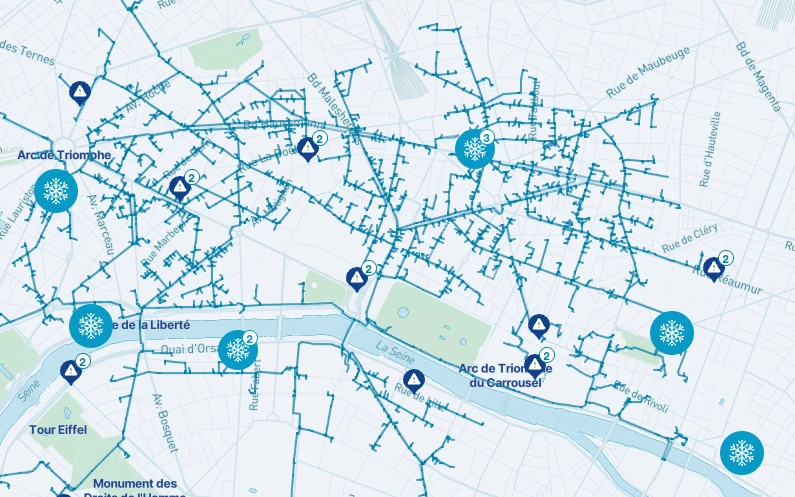
Fraîcheur de Paris runs the City of Paris’ district cooling network, with 120 km of underground infrastructure, 15 production sites, and more than 1,000 connected buildings representing over 7 million m² of cooled space. With 174 employees and €114 million in revenue, the company sits at the intersection of urban infrastructure and energy transition. At that scale, the digital layer connecting the company to its end users becomes operational infrastructure.
That digital layer, a customer portal giving subscribers access to their contracts, account information, and services related to energy consumption and distribution, needed to evolve. The existing platform was built on a stack that made it harder to support the pace of change the business demanded. As the codebase grew, adding new features required increasing care to avoid regressions, and the architecture lacked the modularity needed for safe, iterative delivery.
The user-facing side reflected the same needs. The interface no longer fully matched current digital standards, and the platform fell short of RGAA accessibility requirements, a regulatory concern that carries real consequences in the French public and semi-public sector, and one that needed to be addressed.
Continuing patching a system already at its limits would only increase the cost of the inevitable. The platform needed a complete redesign and redevelopment, modern architecture, clean separation of concerns, a component-based design system, and a codebase built to evolve.
Our Approach to Customer Portal Redesign and Redevelopment
CBTW’s Delivery Center took full ownership of the customer portal redesign and redevelopment, delivering it in two structured phases over four years.
- Phase 1 – Application Development and Portal Redesign (2023–2024)
Our team started upstream of the code. Rather than jumping straight into development, we ran a structured discovery phase to map real user needs, what subscribers needed to do in the portal, where they encountered friction, and what the business required from the platform to operate efficiently. This fed directly into a clear set of business and technical requirements, which shaped a comprehensive User Stories Backlog that served as the single source of truth for the entire development cycle.
With requirements defined, the team moved into UX/UI design, building an interface that prioritized usability, accessibility, and visual clarity from the ground up. Only then did development begin.
On the technical side, the stack was chosen deliberately. A component-based frontend framework drives the user interface, enabling a modular architecture where UI elements are built once, reused consistently, and iterated without touching unrelated parts of the application. A modern backend framework handles server-side logic, providing a stable, well-understood foundation for that layer. A containerized environment supports the entire setup, enforcing parity between local development, staging, and production, and eliminating the class of deployment issues that plague teams working across distributed setups.
The team treated scalability as a hard constraint, not an afterthought. Clean component boundaries. They kept component boundaries clean and structured the codebase so a new engineer can orient quickly and extend the platform safely. As a result, every deliverable, source code, design assets, and technical architecture came together entirely on a custom basis, and CBTW transferred full IP ownership to the client.
- Phase 2 – Corrective & Evolutive Maintenance After Redevelopment (2024–2026)
After go-live, the team transitioned into a maintenance and evolution of posture, resolving corrective issues as they surfaced while continuously shipping functional improvements aligned with the platform’s roadmap. New features were introduced: dark mode, improved navigation flows, enhanced responsive layouts across device sizes.
This phase was the real test of the design and development decisions made in Phase 1. A well-architected platform absorbs change cleanly. This one did. New features landed without regression risk. The modular frontend architecture makes UI iteration fast and predictable. The deployment pipeline kept releases consistent. The platform held under two years of continuous production load and ongoing development, which is ultimately the only proof of quality that matters.
Key Benefits of Moving to a Scalable, Modernized Architecture
- Fully redesigned and modern customer portal: both visually and technically, aligned with current digital standards and built on a clean, modular stack.
- Significantly improved user experience: a redesigned interface that reduces friction, improves usability, and reflects what end users actually expect from a modern digital platform.
- RGAA-compliant accessibility: a thorough review and improvement of the platform’s accessibility layer, meeting French regulatory requirements from day one of go-live.
- New features delivered as standard: dark mode, improved navigation flows, and responsive layouts introduced as native capabilities, not retrofits.
- Scalable and maintainable by design: an architecture ready to support future functional growth, validated by two years of evolutive maintenance without structural rework.
- Full custom delivery, full ownership: all source code, design assets, and technical architecture produced entirely on a custom basis, giving Fraîcheur de Paris complete control over the platform’s future roadmap.
Facing Your Own Legacy Modernization Challenge?
If you’re carrying the weight of a legacy platform, our teams at CBTW can guide you through the same redesign, redevelopment, and legacy modernization process, from discovery to delivery and beyond.