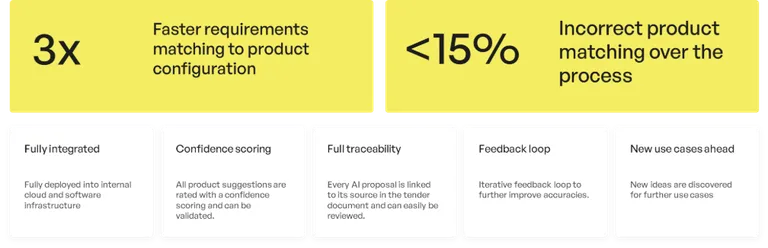





This case study shows how we built a GenAI RfP processing solution on Azure that cut matching time by 3x while keeping human experts in control.
The Challenge
A single RfP can include dozens of documents: specifications, drawings, forms and clarifications, all referencing each other, easily exceeding 100 pages. The information you need is scattered, and no two tenders are laid out the same way. A small municipality and a large corporation structure things completely differently, and that is before you factor in different countries, standards and languages.
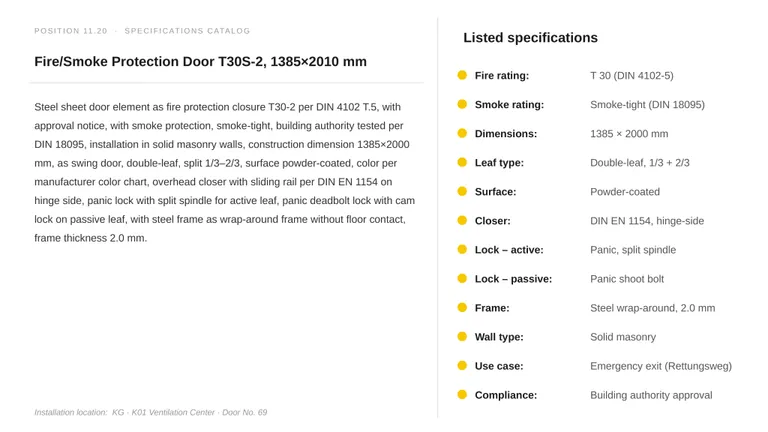
Interpretation starts before any matching can begin. The tender and your product catalog often use completely different words for the same item. Measurements are rarely consistent either: the same dimension can appear as cm, meters, inches or pieces within the same document. Resolving these mismatches requires expertise, and expertise takes time.
Matching each tender position to the right product is where it gets genuinely hard. You are lining up a dozen technical details at once, often with information scattered across the documents, and some details in the RfP may be missing or wrong altogether. Ensuring a valid offer often means going back to the client to clarify.
Offers are legally binding, so a wrong product mapping is not something you can shrug off. It can quickly lead to financial and reputational damage.
Why Not Just Copilot or an Autonomous Agent?
But why not just use a standard Copilot or an autonomous agent? Both can easily fall short.
Offers are legally binding, so a confident but wrong answer carries real financial and reputational risk. A chat interface gives you no confidence signal to tell you which answers to trust. Copilot also cannot reach into the internal configurator or the sales tooling where the real product data lives, so it is missing half the picture. And whatever it produces stays in the chat window, so someone still has to copy it into the actual sales software by hand.
An autonomous agent hits the same reliability problem, plus a deeper one. RfP requirements change, and so does the context around them. A clarification call or a past conversation with the customer can change what the right answer is, and an agent working from the documents alone never sees any of that. Traceability is the real blocker, though. A legally binding offer needs a reasoning trail, so that when a client questions a price months later, someone can actually explain how that number came about.
Both fall short for the same reason. The difficulty here is not writing text. It is getting the reasoning right on incomplete, changing, high-stakes data, and being able to show your work afterwards. That is why we never considered removing the human. The real question was how to take the repetitive work off their plate so they could spend their time on the decisions that actually need a person.
What We Built
Working with our customer, we built a custom AI solution and integrated it directly into the sales software they already used. The goal was not to replace anyone, but to take the repetitive work off their plate while keeping every decision auditable and in human hands. The build rests on three pillars.
The first is knowledge extraction. Generic models match on words, so we grounded the system in the customer’s own domain, using annotated Bills of Quantities and a glossary of synonyms and technical terms. That way the system knows that two differently worded specs can mean the same product. Each suggestion comes with a confidence score, shown in an accessible interface so a sales colleague can see how sure the system is and validate it. The workflow also pulls in customer history and open clarifications, the context an agent working from documents alone would never have.
The second is software integration, because a tool that does not fit the workflow does not get used. The AI features sit as a micro frontend inside the sales portal, where the team already works. Behind it runs a microservice architecture deployed into the client’s own infrastructure, cloud-agnostic and provisioned via Terraform. Furthermore, we built the solution for low latency and high interactivity.
The third is traceability and governance, which is what makes human-in-the-loop a fundamental part of the solution. The AI proposes, a sales colleague verifies, and only then does anything go out. Every interaction is logged, so there is always a reasoning trail behind a legally binding offer.
One thing that is easy to underestimate at this document volume is token cost. It adds up quickly, so we handled it early with prompt caching and token optimization to keep the solution affordable at scale.
The Result
The RfP process is now up to 3x faster. What previously took days now takes hours. The team spends less time on manual document analysis and more time on the decisions that require human judgment: edge cases, customer clarifications and final validation.
Speed was only part of it. The solution also brought consistency. Every tender is processed with the same logic, the same terminology resolution and the same audit trail. For a team handling legally binding offers, that consistency is not just a process benefit, it is a risk reduction.
Instead of spending hours reading through documents and manually cross-referencing product catalogs, the team can now focus on the cases where their knowledge and judgment matter.